International Nursery – What Does It Mean?
A Baby's Brain Absorbs Languages Like a Sponge - Don't Miss a Key Moment in Language Development
So take advantage of the opportunity and let your children participate in classes and fun activities at the private ITSW multilingual nursery in Warsaw. This participation will allow them to immerse themselves in the language and effortlessly acquire two other languages from the age of one.
Don't wait until your child starts primary school. Some say that students can learn a language starting from the primary school. This is definitely too late. Language is a tool we acquire from the first days of life. The only limit to the languages you can master is the time required for immersion in each of the languages we want to surround your child with. This time is needed for a child to first understand the language and then produce it, i.e., speak it. Activities and games at a private multilingual nursery guarantee this.
So why not capitalize on these innate and natural skills, since it's easiest for children aged 1-1.5? We feel proud when we see preschoolers performing a 45-minute performance in Chinese.


Don't Miss The Most Important Moment - Little Kids Are Language Geniuses
Young children are born with an extraordinary ability to learn languages. Scientists confirm that in the first years of life, a child's brain can acquire any language spoken in the world, and the pace of linguistic development is at its highest. This is a so-called critical window, a short period during which language learning comes naturally and effortlessly to a child.
After the age of two, this ability gradually begins to decline—which is why it's so important not to miss this moment. Early language immersion, such as the one offered at the ITSW nursery, allows the child to hear languages every day and build true multilingualism.
You, the parent, decide what opportunities open up to your child. With early language learning, your child can grow up as a full native speaker of up to three languages, with skills that will benefit throughout your child's entire life.
What Is Language Immersion and Why Should It Start in The First Years of Life?
This is a linguistic process during which your child is immersed in the language spoken by native speakers in all everyday situations, where the target language is the sole means of communication. In a private multilingual nursery, immersion means that all daily activities, as well as activities and play at the nursery—from diaper changes to potty training and singing lullabies—will be conducted "in the specific language" spoken by the caregivers. If the multilingual nursery is trilingual, the child will be cared for by three native speakers, each speaking a different language at designated times of the day or week, as well as during activities and play at the multilingual nursery. This respects the OPOL principle (one person, one language).


Don't be afraid that your child won't understand everything at first. Babies understand this lack of understanding as a natural occurrence. That's how they learn. Let your child use this natural ability to feel comfortable not understanding . This skill leads to acquiring new language skills in everyday contexts, but surrounded by warmth and care.
What Is The OPOL Method and How Does It Work?
This approach is based on assigning a language to a specific person, meaning that one person speaks to the child in only one language. This is a popular method used by parents who wish to raise bilingual children simultaneously. OPOL plays a crucial role in early language learning in a multilingual nursery because it allows children to assign one language to one person. The OPOL method is a helpful tool for supporting children in strategies to end language mixing, which is a natural process in itself. OPOL will also support caregivers in developing future language skills and vocabulary.
Don't stress about your child mixing languages or not performing well enough at school in the language of instruction. Mixing languages is completely natural in young children. Little ones don't try to speak correctly; they communicate through various means and in different languages. They just need to be surrounded by appropriate language models. And that's exactly what happens at the ITSW multilingual nursery!


What Languages Do Children Learn at The ITSW Nursery?
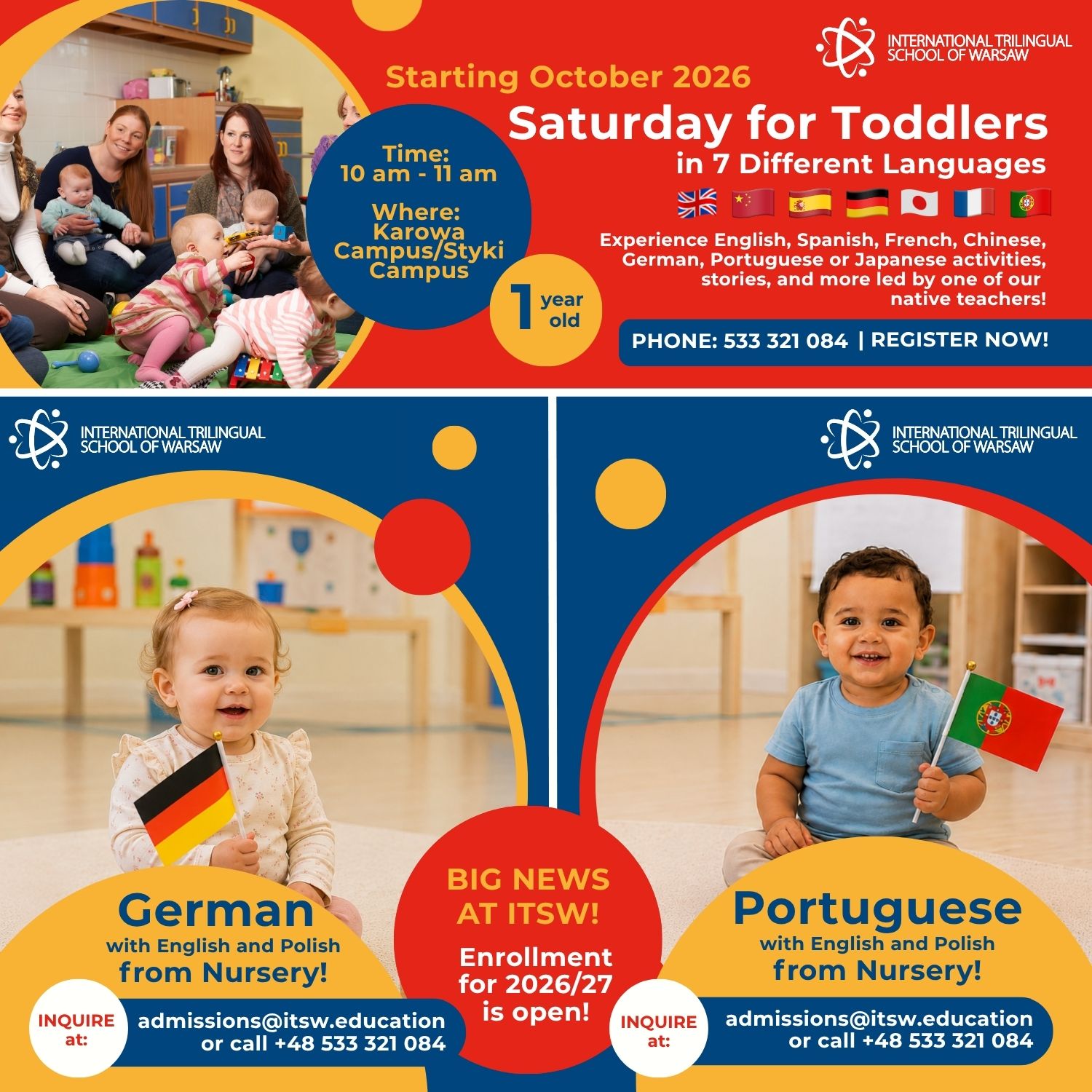
At ITSW, children are immersed in a natural, multilingual environment from a young age. In addition to English and Polish, children learn one of the world languages: Spanish, French, Japanese, Chinese, Portuguese or German.
Parents choose their child's third language, and the child is placed in a trilingual group where they interact daily in a multilingual environment, for example:
English + Spanish + Polish
English + French + Polish
English + Chinese + Polish
English + Japanese + Polish
English + German + Polish
English + Portuguese + Polish
Each group is led by native-speaking teachers, allowing children to learn languages naturally through daily play, relationships, and a variety of activities.
This is why our students grow up in a friendly, multicultural environment and develop language skills at a level that is difficult to achieve later in life.
Yes, language acquisition in children still looks like a miracle—and in a sense it is, because only young children can learn languages so quickly and effortlessly.
FAQ – Frequently Asked Questions About the ITSW Multilingual Nursery in Warsaw
Parents often ask how immersion, the OPOL method, and trilingual education work in our nurseries in Śródmieście and Saska Kępa. Below you will find the most important answers about natural language acquisition, daily activities, and children's developmental safety.
Isn't language immersion too difficult for such young children?
No- young children are the ones who learn languages most easily. Their brains are the most plastic, so they acquire language as naturally as walking or eating.
Language immersion at the ITSW nursery in Warsaw is a natural environment for them, not a burden.
Will my child mix languages in a trilingual nursery?
Mixing languages by toddlers is a completely natural stage of development. It's important not to "avoid mixing," but to surround the child with correct language patterns, provided by ITSW teachers, who allow the child to assign a language to a person. This is a natural process in which, at a certain point, toddlers begin to understand where a given language "begins and ends." Then they assign a language to a person.
Does a child have to understand everything to start learning a language?
No. Children see the lack of full understanding as natural—and therefore learn faster.
At ITSW nurseries in Śródmieście and Saska Kępa, immersion takes place in everyday situations: during play, meals, walks, and daily rituals.
What does language immersion look like in practice at an ITSW nursery?
The child is surrounded by native speakers during all activities:
• diaper changing,
• eating,
• naps,
• play,
• group activities.
At the ITSW trilingual nursery, each teacher and caregiver speaks only their own language (OPOL principle), which provides the child with a clear and consistent language environment.
What is the OPOL method and why is it so effective for children?
OPOL (One Person One Language) means that each teacher always speaks to the child in one language. This allows the child to effortlessly assign a language to a person and develop trilingualism naturally—without chaos and pressure. This is the most effective language learning method for this age group. Native speakers create a real language environment, not a classroom learning environment. It’s thanks to them that immersion is so effective.
Are the three languages too much for my child?
No. Young children don't learn languages like adults—they acquire them intuitively through relationships, play, observation, and daily rituals.
Three languages come naturally to them if they are introduced in a warm, consistent environment—as the one at ITSW.
How quickly will I see the results of language immersion in my child?
Every child develops at their own pace—first comprehension appears, then individual words, and then sentences.
Parents of our little ones often notice their first reactions to a foreign language after just a few weeks of regular immersion.
This Is How Language Immersion Works. Listen to Our Two-Year-Old Students!
Learning languages from an early age is a subject of interest for many scientists. Learn how young children learn languages.