
The OPOL (One Person, One Language) method is one of the strategies used in bilingual and multilingual parenting. Its basic principle is simple: one person consistently communicates with the child in one language, and each subsequent person communicates in another. In practice, however, bilingualism and multilingualism are not based solely on the division of languages. Equally important are regular contact, natural communication situations, and the way languages function in the child’s daily life.
For young children, language isn’t just a collection of words and grammatical rules. It’s primarily a tool for building relationships, learning about the world, and expressing emotions. Therefore, effective bilingual education requires, above all, creating an environment in which the child has the opportunity to freely engage with both languages.
Table of Contents:
- What is the OPOL Method? — One Person, One Language in Practice
- What if different languages are spoken at home? — How to separate languages in the family
- What does OPOL look like at home? — specific real-life situations
- Mixing languages in children is not a mistake, it is a natural stage
- What to do when OPOL is difficult to follow? — the most common pitfalls
- OPOL at home + language nursery – how these two environments complement each other
- When the OPOL method starts to bring results – what to expect and when?
What is the OPOL Method? — One Person, One Language in Practice
OPOL, or One Person, One Language, involves assigning a specific person to communicate with the child. For example, one parent might speak Polish, while the other speaks English, French, or another language. This allows the child to gradually associate that person with a specific way of communicating.
In the simplest model, the mother uses one language and the father the other. If one parent speaks Polish and the other French, the child hears both linguistic systems in everyday situations from the very beginning. However, this doesn’t mean that every conversation has to follow a rigid pattern. What remains crucial is a dominant communication pattern and regular exposure to both languages.
Language emerges during ordinary activities—eating together, walking, playing, reading, or getting ready for bed. As a result, it doesn’t become a separate subject of study, but a natural element of relationships with others.
The most important assumptions of the OPOL strategy are:
- assigning one language to a specific person,
- the child’s regular contact with both languages,
- consistent way of communication,
- using language in natural situations,
- no pressure to reach a certain level quickly.
OPOL is one of many strategies supporting the development of multilingualism. Not every family will use it exactly the same way. In some cases, a more flexible approach works better, where language is assigned not to a person but to a specific situation, such as spending time together. In such moments, parents can consciously choose to communicate with their child in English.
One example is the T&P (Time and Place) strategy. In this model, one language might appear, for example, during shared reading, and the other during play or specific activities. This approach can be especially helpful when strict division by person is difficult to maintain.
Bilingualism researcher Barbara Zurer Pearson highlights many myths surrounding raising children bilingually. The mere presence of two languages is not a barrier to a child’s development. What matters most is the quality and regularity of contact with each language.
What if different languages are spoken at home? — How to separate languages in the family
Not every family needs to use the OPOL method. The choice of how to support bilingualism depends on factors such as the family situation, the languages spoken by the parents, and the dominant language in the child’s environment.
For families living abroad, the Minority Language at Home model often works well, with the minority language being primarily used at home. For example, a Polish family living in the UK might communicate in Polish at home, while the child naturally learns English outside the home—at nursery, preschool, school, or through interactions with peers.
In such an arrangement, the family’s native language receives additional support in everyday relationships because the child has regular contact with it also outside the external environment.
The situation is different for families where parents speak different native languages. In such cases, OPOL often becomes a natural solution. The mother can speak Polish to the child and the father Italian, allowing the child to gradually learn that different people can communicate with them in different languages.
When choosing a strategy, it is worth considering:
- parents’ native languages,
- the language of the child’s environment,
- the language with which the child has the least contact.
On this basis, the family can decide whether OPOL, a minority language at home, or a combination of several solutions would be better.
The development of bilingualism and multilingualism is also supported by everyday activities—shared reading, songs, conversations, games, and contact with people who speak the same language. Actual communication is particularly important. Simply listening to stories or recordings in a second language is no substitute for conversation and building relationships.
There’s also no need for a child to receive exactly the same amount of exposure to each language from the start. In practice, the proportions may change depending on life stage, location, and daily activities. The most important thing is that exposure to languages remains natural and not associated with pressure.
What does OPOL look like at home? — specific real-life situations
The OPOL method demonstrates its principles best in everyday, ordinary situations. It doesn’t require additional lessons or a separate learning plan. Its foundation is the presence of language in a relationship with a loved one—during conversation, play, shared meals, or evening reading.
For example, a mother might speak to a child in Polish, and a father in English. During breakfast, a walk, or playing together, each parent addresses the child in their own language. The child doesn’t always have to respond in the same language in which the question was asked. If the father asks in English and the child replies in Polish, it doesn’t mean the strategy stops working.
In such a situation, maintaining natural communication is paramount. Parents can continue the conversation in their own language, rather than interrupting and demanding an immediate response in a specific language. Above all, the child needs contact and the sense that language is for communication, not for checking correctness.
It’s important to avoid situations where the second language becomes solely a test subject. Instead of asking, “What’s this item called in English?”, it’s better to simply use the word in a natural conversation. This allows the child to experience the language in a specific context and more easily connect words with their meaning.
The development of bilingualism can be supported by, among others:
- reading books together in two languages,
- songs and rhymes,
- language games,
- conversations with grandparents or relatives who speak a given language,
- meetings with other people who use this language.
If a second language appears primarily in contact with one parent, it’s worth seeking additional opportunities for the child to hear it in other relationships as well. This way, the child begins to understand that it’s not just “Mom’s language” or “Dad’s language,” but a real way of communicating with others.
It’s not always possible to maintain perfect consistency. Everyday life brings various situations—family conversations, trips, meetings, and moments when it’s more convenient to use a different language. Individual deviations don’t invalidate the entire strategy. The overall way languages function within the family remains paramount.
Mixing languages in children is not a mistake, it is a natural stage
Language mixing is a common phenomenon among bilingual children. A child may begin a sentence in one language and finish it in the other, or use a single word from one language while speaking in another.
This doesn’t mean that a child doesn’t distinguish between languages or that multilingualism is developing incorrectly. Children use all the linguistic resources available to them. If a particular word in one language is easier to recall at a given moment, they may naturally reach for it.
For example, a child may know the name of a specific item in English but not yet remember its Polish equivalent. Using the English word allows them to convey their idea—so from a communication perspective, it’s a natural solution.
Common situations include:
- using single words from a second language,
- difficulty remembering a specific term,
- responding in a language other than the one used by the interlocutor,
- creating statements containing elements of both languages.
At such moments, there’s no need to pause the conversation and correct every word. A better approach is to calmly repeat the statement in the appropriate language. This provides the child with a correct model while maintaining natural communication.
The development of multilingualism or bilingualism is a process that unfolds over time. Especially in the case of languages that emerge less frequently, it may happen that a child understands more than they speak for a period of time. The difference between understanding and actively using language is part of many developmental processes.
Barbara Zurer Pearson points out that many fears and misunderstandings have arisen around bilingualism. One of them is the belief that intertwining languages means a child will become lost. In fact, intermixing can be a natural stage in using two developing language systems.
What to do when OPOL is difficult to follow? — the most common pitfalls
The OPOL method is simple in concept, but its daily implementation isn’t always easy. Parents may struggle with fatigue, changes in family circumstances, or the moment when a child begins to respond exclusively in their dominant language.
One of the most common challenges is the belief that a strategy will only be effective if it’s executed perfectly. However, consistency doesn’t mean the absence of deviations. Maintaining a clear communication pattern over the long term is far more important.
Difficulties may arise especially when:
- the rules of communication change frequently,
- the child has few opportunities for contact with the minority language,
- the second language begins to be associated mainly with testing knowledge,
- there is pressure for the child to always respond in a specific language,
- parents expect very quick results.
A typical example is when a parent speaks to a child in English and the child responds in Polish. Trying to force a correct response in a second language can make communication feel like a drill rather than a natural conversation.
A better solution is to continue the dialogue in the chosen language. This way, the parent demonstrates the correct model, but at the same time allows the child to freely participate in the conversation, in which case they paraphrase what the child said in English.
It’s also worth remembering that the strategy may change depending on the family’s circumstances. A child starting school may have significantly more exposure to the language of their surroundings than before. In such cases, additional opportunities to use the minority language can be helpful—family gatherings, trips, language classes, or interactions with other children.
One of the greatest benefits of OPOL is that language remains a part of everyday interactions. There’s no need to create additional “lessons” to support second-language development. Simply put, it becomes a natural way to talk, play, and spend time together.
OPOL at home + language nursery – how these two environments complement each other
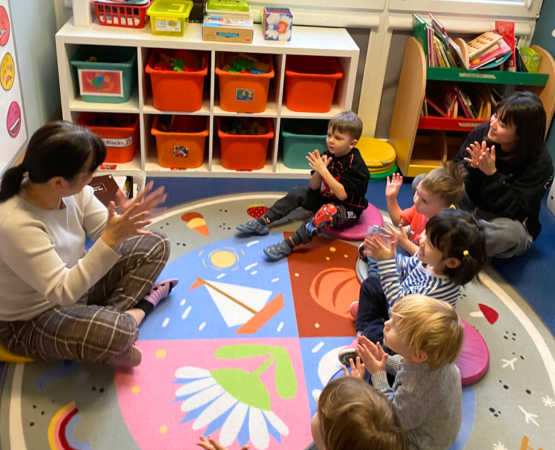
Home and educational institution can create two complementary environments that support the development of bilingualism. At home, language most often emerges in relationships with loved ones—during conversations, shared activities, and daily rituals. In a nursery or preschool, however, a child may experience it through contact with teachers and peers.
This is especially important when it comes to languages that are less present in everyday environments. While one parent can provide the child with regular and valuable contact, the additional environment demonstrates that the language can also be communicated outside the home.
For example, a family living in Poland might use OPOL—the mother speaks English and the father speaks Polish. In this case, English may be less present in the child’s natural environment. Contact with a setting where the language appears in everyday situations allows for more opportunities to use it.
Combining different environments can support:
- regular contact with the language,
- development of communication skills,
- listening to different ways of speaking,
- building language awareness,
- learning about the culture associated with a given language.
It’s important to remember, however, that an educational institution doesn’t replace everyday communication at home. Language development occurs most naturally when a child has the opportunity to use it in a variety of situations and relationships.
In bilingual and multilingual families, a nursery or preschool can be especially helpful when one language is less frequently spoken. This additional environment allows the child to hear it spoken with others, not just with one family member.
This doesn’t mean, however, that a bilingual or multilingual setting is a necessary component of bilingual or multilingual upbringing. Dual language development can also occur without it. It’s one of the tools a family can utilize if it suits their needs and way of functioning.
When the OPOL method starts to bring results – what to expect and when?
With the OPOL method, there is no single, defined point at which a child should begin speaking a second language fluently. Each child develops at their own pace, and many factors influence this process, including frequency of language exposure, family circumstances, and the environment in which the child grows up.
The first noticeable effect is often not yet speaking, but understanding. A child begins to respond to a parent’s utterances, recognize frequently used words, and associate specific language with a specific person or situation.
Over time, it may:
- understand increasingly complex messages,
- use single words,
- create short statements,
- use the language more and more freely in everyday situations.
The development of both languages doesn’t have to be identical. One may dominate for a time—especially if it’s used more frequently in daycare, preschool, school, or in interactions with peers. Over time, the proportions may change.
It’s also worth remembering that language proficiency isn’t always the same in every situation. A child might communicate very well with a loved one but have a limited vocabulary in more specialized areas. This is natural, as competence develops with experience and communication needs.
The effectiveness of OPOL should not be judged solely by whether a child speaks identically in both languages at a given age. What matters more is whether they understand messages, use language to build relationships, and gradually develop their skills.
Bilingualism should not be considered an automatic cause of difficulties in speech development. For children raised bilingually, it is crucial to observe the entire process and provide them with regular and natural exposure to each language.
In the long term, the goal of bilingual and multilingual education is the ability to function freely in diverse environments, to engage with cultures, and to be open to communicating with others. However, this is not a task that must be completed according to a specific schedule.
OPOL works best when it’s part of everyday life. Parents don’t have to “teach the language” all day—they simply use it when talking, playing, joking, comforting, and spending time together. This allows the second language to become a natural part of the relationship, not an added burden.